Holding On, Letting Go:
Why I Wrote This Book
By Michaela Gordon, OTR/L
I published Holding On, Letting Go at the end of last year, but the story itself had been with me for a long time.
It was a book I kept coming back to—one that unfolded over time. It began as a quiet contemplation, and when I first put it into words, it came quickly. But shaping it into something that felt safe for children and meaningful to share took time, care, and intention.
There were experiences that made me think about what it means to love someone, to grow, and eventually, to let go.
Watching families move through change—especially when a child is involved—has a way of staying with you. It invites questions that don’t always have easy answers.
At the same time, I was in a season of change myself—and that, too, became part of the story.
There are moments in life that bring you face-to-face with what really matters. Moments that shift your perspective. Moments that ask you quietly but persistently, to hold on to what is meaningful… while also learning how to let go of what you can’t control.
That tension—between holding on and letting go—became the heart of this book.
As an occupational therapist, I often think about how much our sense of safety comes from the rhythms of our lives. The people we see every day. The routines we rely on. The connections that ground us.
When those are disrupted—whether through loss, change, or uncertainty—it can feel incredibly disorienting.
For children, this can be especially hard.
Grief doesn’t look the same for every child. Some want to talk. Some don’t. Some ask questions, and some process through play, movement, or simply being close to someone they trust.
There is no one right way.
Our role isn’t to rush them through it—it’s to meet them where they are.
In occupational therapy, we support children by helping them feel safe in their bodies, regulated in their nervous systems, and connected to the world around them. We help rebuild a sense of predictability through routine, relationship, and meaningful activity.
Sometimes, a story can become part of that support.
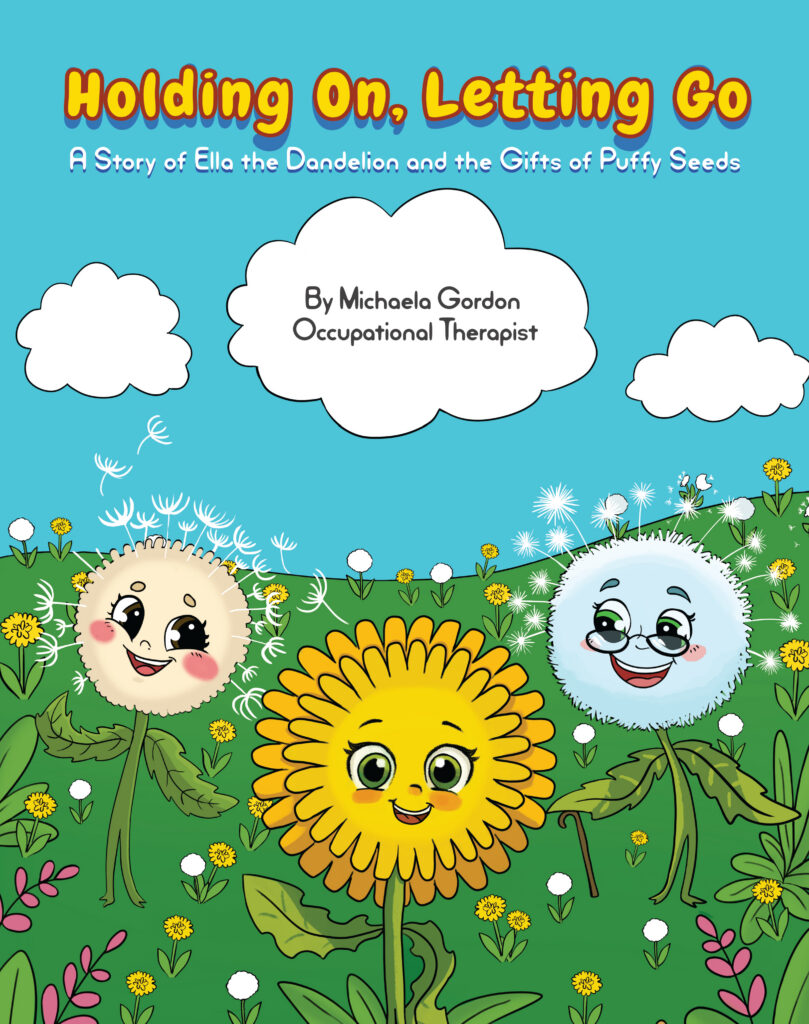
Holding On, Letting Go tells the story of Ella, a little dandelion, and the conversations she shares with her mom and grandma as she begins to notice change. Through their relationship, she learns that life is always moving—growing, shifting, and evolving—and that love continues, even when things look different.
If you had asked me ten years ago if I would be writing children’s books, I would have said no. But I wrote one—and then I wrote another. This was the second.
I was hesitant to share it. It holds a sensitive and meaningful topic, and that carried a lot of weight for me. But the story came to me in a way that felt clear and important, and I knew it was something I needed to write.
Since publishing it, I’ve been able to share this book with families during moments when they needed it most. I’ve also shared it with individuals who have experienced loss, and it has brought them great comfort. You’re truly never too old for a children’s book.
Some of us are preparing for change.
Some of us are moving through loss.
And some of us are simply trying to find the right words to support the people we love.
What I’ve learned is this:
It’s not just a children’s book.
It meets people wherever they are.
Because there’s a part of us that’s still learning how to hold both joy and pain… how to stay present with all that we love, while also making space for what we can’t hold on to forever.
My hope is that this book offers a gentle place to begin.
A way to open conversations.
A way to sit with big feelings.
And a reminder that even in letting go, love doesn’t disappear—it continues on, in ways we can still feel.
If you feel like this book could support you or someone you love, you can find Holding On, Letting Go here:
https://a.co/d/05xJWlhS
It’s one of those books people often don’t think they need—until the moment they do.