Why I Stopped Telling Children to “Pay Attention” — The Story Behind
Cal and His Amazing Attention Pie
Why I Stopped Telling Children to “Pay Attention” — The Story Behind
Cal and His Amazing Attention Pie
By Michaela Gordon OTR/L
I remember sitting in a class somewhere around 2006 or 2007 when the instructor said something that stayed with me. Researchers could measure different aspects of attention, but attention itself wasn’t nearly as simple as people often made it sound. That comment stuck with me, partly because I had spent much of my own life hearing the same words many children hear: “Pay attention.”
What always puzzled me was that I thought I was paying attention.
I wasn’t staring at the teacher or necessarily listening to directions, but my mind wasn’t empty either. I was thinking about something. Planning. Daydreaming. Remembering the feeling of my body moving through the water as I swam. Following butterflies while the soccer game carried on around me. Watching other people. Wondering about something I was touching. My attention had gone somewhere.
That question stayed with me:
If I’m always paying attention to something, then what exactly do people mean when they tell me to “pay attention”?
Years later, while working with a little girl in therapy, I began experimenting with that question. Instead of assuming she wasn’t paying attention, I wondered whether her attention was simply somewhere different than where the adults around her wanted it to be.
Originally, I thought about three spaces: Mental Space, People Space, and Touch Space.
Mental Space was where thoughts lived. It was planning, remembering, imagining, daydreaming, and simply letting your mind wander. Sometimes we drift into Mental Space and don’t even realize it. Other times, it’s where our creativity and best ideas come from.
People Space was harder to describe. It wasn’t just about socializing. It was more about sharing awareness with others and understanding what the moment called for. A child crossing the street with Mom, participating in a lesson, having a play date, or working together with friends might need a larger People Space. People Space wasn’t about everyone doing the same thing. It was about being aware of what was happening around you and what was expected in that moment.
Touch Space originally meant touching things, but over time I realized it was much bigger than that. It wasn’t just exploring objects with our hands. It included fidgeting with your feet, leaning against furniture, rolling on the floor, tilting your chair back, pressing your body into things, and becoming completely absorbed in building, creating, or feeling the physical world around you. Sometimes Touch Space can help us focus, and other times it can become so big that everything else disappears.
Years later, after learning more about interoception, I realized something was missing: Body Space.
Our bodies are constantly sending us messages in the background. Hunger, fatigue, temperature, the need to use the bathroom, anxiety, excitement—the list goes on. Our bodies are constantly helping us regulate and letting us know what we need. Sometimes those signals are quiet, and sometimes they become so loud that they naturally take up more of our attention.
Eventually, I realized something important: people are almost never paying attention to nothing. Even when our attention isn’t where others expect it to be, it’s usually somewhere.
Even while we sleep, our brains are still processing information. Most of us are never completely in one space. Instead, our attention is divided among thoughts, physical sensations, touch and movement, and awareness of the people and events around us.
That’s where the idea of the pie chart came from.
I began thinking about attention as a pie whose slices could grow bigger or smaller.
The spaces themselves weren’t good or bad. Bigger wasn’t always better.
The question wasn’t, “Which space should I get rid of?” The question was, “What size should each slice be right now?”
If you’re riding in the car on a road trip with a book in your hands, it makes sense for Mental Space and Touch Space to be larger while People Space becomes smaller.
If you’re crossing the street with your mother, People Space needs to become much bigger.
If you’re creating artwork or building something, Touch Space may become the largest space and help you stay engaged.
If you’re anxious before performing in front of others, your Body Space may suddenly become huge because your racing heart, sweaty hands, and butterflies in your stomach are telling you that something important is happening.
Or maybe you’re in a museum and someone reminds you not to touch the exhibits, but you find yourself fascinated by the texture of the paint sticking up from the canvas or the tiny details on a sculpture. If your Touch Space becomes much bigger than your People Space, you may end up frustrating the people around you, accidentally breaking something, or feeling bad afterward—not because you’re bad or because you weren’t paying attention, but because your attention was focused in a space that wasn’t the best fit for that particular situation.
Sometimes our spaces help us. Sometimes they don’t fit the situation. The important part is learning to notice.
For some people, especially those with ADHD, that process can be harder.
There are many systems involved. Executive functions help us plan and think ahead. Sensory systems provide information that helps us regulate. Alertness systems help us wake up and sustain attention. Motivation and reward systems influence what feels interesting enough to stay with. Anxiety and emotions can also take over and make it difficult to think clearly.
Attention isn’t one thing. It is many systems working together.
Which is why I gradually became less interested in telling children to “pay attention.”
Of course, I still catch myself saying it sometimes. We all do. Life gets busy, and sometimes we’re trying to stop something quickly. But over time, I realized that repeatedly saying “pay attention” wasn’t really teaching a skill.
Nothing changes simply because someone hears those words.
First, we have to figure out where our attention is. Then we can take actionable steps to shift it.
Instead of asking children to “pay attention,” I became more interested in helping them ask:
“What am I paying attention to right now?”
“What space am I in?”
“What space would help me the most?”
Because if we’re forever reminding children to pay attention without helping them understand where their attention is, no skill is really being built.
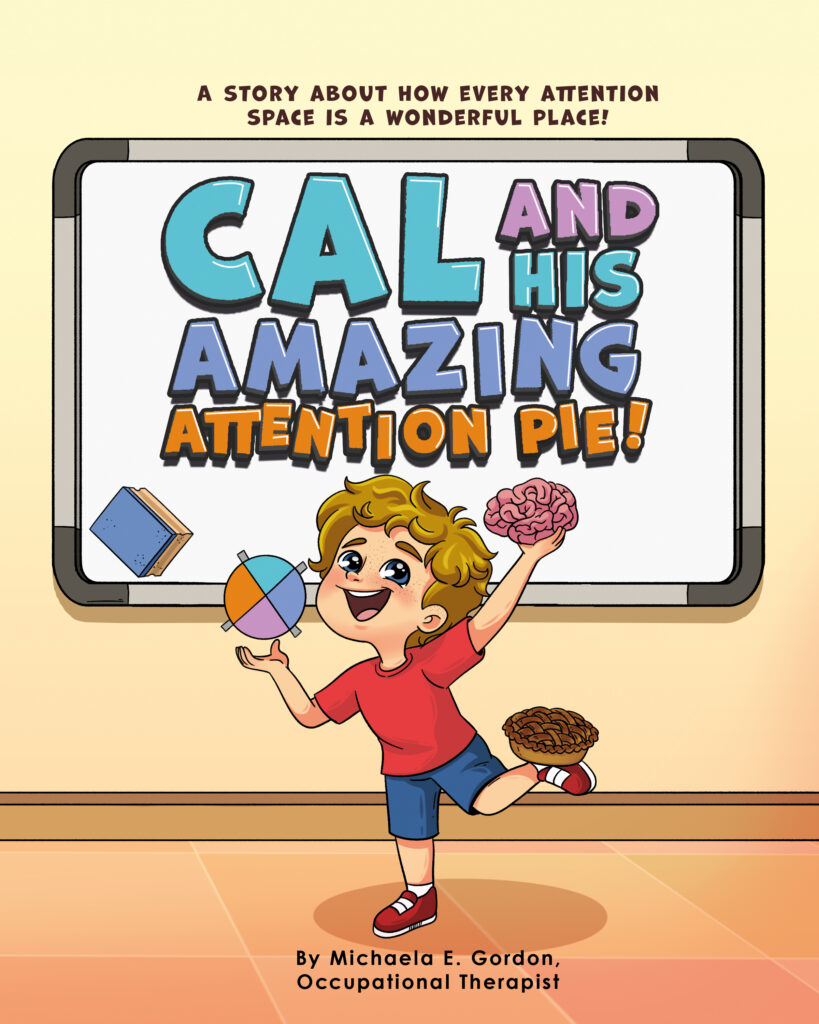
I wanted to find a way that I could share this concept with others, which is why I wrote Cal and His Amazing Attention Pie.
Through Cal’s classroom presentation, children are introduced to Body Space, Mental Space, Touch Space, and People Space. They learn that no space is “good” or “bad.” They discover that attention is always changing and that they can learn to notice where they are and make adjustments when needed.
The book is filled with humor and grace because I believe that is the way it should be. We want kids to feel curious and accepting of all parts of themselves.
Struggling with attention is not a moral failure. In fact, many children are doing amazing things in the spaces they naturally spend time in. The key is timing and learning how to shift so they have some agency over how they spend their time. This gives them opportunities to grow—not only in the areas where they are already strong, but also to develop other skills that will support them throughout their lives.
I also wanted the book to support the adults who care for children. That’s why the back of the book includes resources for parents, teachers, and therapists. I explain some of the brain systems involved in attention, offer practical sensory and cognitive supports, and provide ideas for helping children build awareness and flexibility instead of relying only on reminders like “Pay attention.”
My hope is that children come away with a new understanding of themselves.
My hope is that children stop asking, “What’s wrong with me?” and start asking, “What am I paying attention to right now, and is it helping me?”
Because attention isn’t something children fail at. It’s something they can learn to notice, understand, and gradually shape.
If you’re interested in learning more, you can pick up a copy of Cal and His Amazing Attention Pie on Amazon and use it as a shared reference with the children in your life. My hope is that the story and caregiver resources will provide a common language that helps children, families, teachers, and therapists better understand attention together.